


F-1 Visa for International Students
The United States has one of the most robust and well-known university systems in the world. Students who want to study abroad in the US need a US student visa to take classes and reside temporarily in the country. The most common US student visa that international students can apply for is called the F-1 visa. Students can apply for an F-1 student visa for both undergraduate and graduate studies. Over 6,000 different partner colleges in the United States accept this kind of visa.
The process for obtaining an F-1 visa is complex. There are several steps that students must follow in order to get their hands on one. Applicants must meet extensive student visa requirements to study in the US, but the benefits are numerous for those who qualify.
In this article we will discuss student visa requirements for the F-1 visa as well as its benefits and limitations. Some topics we will cover include:
- The F-1 visa meaning and why students need them
- Eligibility requirements for the F-1 student visa
- How to get a student visa once you’re accepted to a university
- The timeframe for getting an F-1 visa and how long do student visas last
- What people can and cannot do with student visas
- How to prepare for visa interviews and demonstrate English proficiency for an international student visa
- Why people apply for student visas like the F-1 visa
If you’re ready to learn all about the F-1 visa, read on!
What is an F-1 visa?
Before getting into the application requirements, let’s start by talking about the F-1 visa meaning. The F-1 is an international student visa, not a US student visa. This means that the F-1 is for students who live outside the US — not students in the US who want to study abroad. Additionally, the F-1 visa is an international student visa, not an immigrant visa. That means it’s a temporary document meant for people pursuing higher education in the US, not for those looking to permanently immigrate. So in short, the F-1 visa meaning says it’s for students hoping to stay in the US temporarily for their studies.
F-1 visas are the most common student visas for international students studying abroad in the US at four-year universities or graduate programs. They’re different from the M-1 visa, which is for those pursuing trade or vocational programs, not bachelor’s or graduate degrees. Students on an M-1 visa have more limited options for the program they attend. However, they are able to pursue more on-the-job training along with their studies.
Students must gain acceptance to a partner school in order to apply for an F-1 visa. The school must have a federally issued SEVP certification in order to accept students studying under an F-1 student visa. You can check whether the school you want to apply for has this certification by searching the US Department of State website.
You should apply to your chosen school as early as possible. The earlier you apply, the earlier you can show proof of acceptance to begin your F-1 visa application. Once a college has accepted you, they should send a Form I-20, which you need for next steps.
Who is eligible for an F-1 visa?
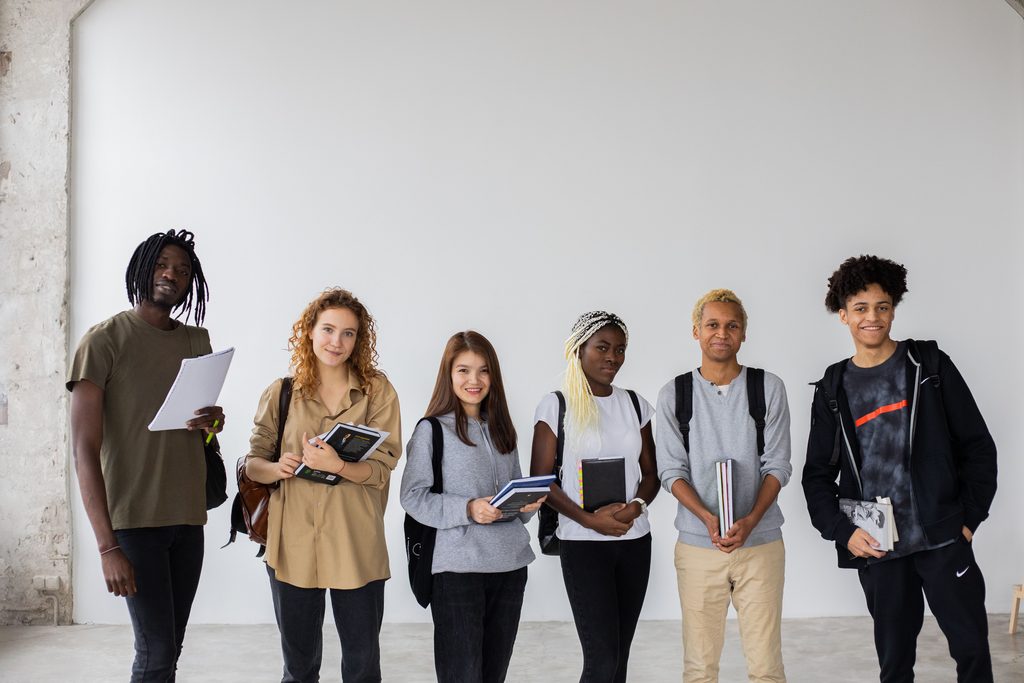
As previously mentioned, only students who’ve been accepted to an eligible partner college or university can apply for the F-1 student visa. You must be pursuing an accepted 4-year or graduate degree program in order to apply for an F-1 visa. Specifically, you must be taking a full course load and making satisfactory progress toward your degree throughout your time in the US. Student visas are incredibly specific, and eligibility requirements include specific criteria outlined in the instructions for how to get a student visa.
In addition to the academic requirements, the F-1 visa application requires demonstration of students’ readiness for their intended academic program. This includes being accepted through the school’s international student application process. It also includes having strong grades in secondary school courses in your home country.
You must also demonstrate financial capabilities to live and support yourself through your studies. This is because students on an F-1 visa have limited options for employment while in the US. This financial aspect is another reason we recommend starting the application process early. Starting early gives you time to secure necessary funds or aid as well as pay required fees.
Are there other US student visas?
There are three main student visas that can be used to study at American colleges or universities. Each of these different student visas is used for different purposes.
- F-1 visa: For students accepted to a four year or graduate degree program.
- M-1 visa: For students pursuing a trade or other certification program.
- J-1 visa: For professionals intending to work temporarily in the US before returning to their home country.
F-1 and M-1 visas are strictly student visas with limited opportunities for work outside of school study. On the other hand, the J-1 is far more flexible and intended for those looking for employment in addition to academic opportunity. J-1 visa holders may be researchers, lecturers, or other faculty.
If your goal is to obtain a bachelor’s or graduate degree from an American college or university, you need an F-1 visa. The M-1 and J-1 visas aren’t for your situation. Each international student visa is unique, so it is important to apply for the correct one that fits your goals. Other categories of visa, like B tourist visas, cannot take the place of student visas.
How to Apply for an F-1 Visa
Filling out an F-1 visa application requires several steps, as there are many student visa requirements that applicants must meet. The first step to obtaining a US student visa is to earn an acceptance from an eligible college or university. Once that happens, a designated officer at the school will send you a Form I-20 to complete. That I-20 form must be filled out and brought with you to the interview. Failure to do this will result in delays in your F-1 visa processing time because you’ll need to reschedule your interview.
Additional Documents
Besides the form I-20, there are a few additional documents to complete before you can move forward with your F-1 visa application. One of the F-1 visa requirements is to have a valid passport for travel to the US. The passport must include a photo and be valid for at least six months after your planned departure date. You must also complete the DS-160 form and pay required fees, both for SEVIS and for the visa application itself, which total $535.
Finally, you will need academic transcripts to show your preparedness to enter the program of study you’re applying for. You may also need to provide bank statements that show you can pay for educational expenses while in the US. The US doesn’t provide federal student aid to international students, and work opportunities are limited. Therefore, you will need to prove that you can afford the costs at the university you want to attend. You can find guidance on education costs in the US and where to find quality, affordable schools here.
Once you have completed your forms, the final step in the process is to schedule an interview. These interviews typically happen at the US embassy or consulate in your home country. The interview is the final step of the F-1 visa application process; make sure you bring all your required documents to your interview. The questions cover both your academic and financial readiness for study abroad in the US. Carefully review your academic transcripts and financial records ahead of your interview to ensure you’re putting your best foot forward.
How long does it take to get an F-1 visa?
The F-1 visa processing time can vary greatly for each person. Your home country, application date, and the need for additional document reviews can all impact when you get your visa. Scheduling your interview tends to be the most time-consuming part of the application process for the F-1 visa. To get ahead, try to schedule your interview as soon as possible. You can use the global visa wait times website to see when consulates or embassies in your area are scheduling interviews.
The length of the F-1 visa processing time also means that you should apply to schools as early as possible. US student visas require proof of acceptance in order to complete any of the other steps in the process. Student visas can be obtained up to a year before the start of your academic program, so starting early can be beneficial.
However, it is important to remember that even after obtaining your F-1 student visa, there are limitations on entry. You may not enter the United States until 30 days before your degree program starts. What about departure — how long do student visas last? Students on F-1 visas must leave the United States within 60 days of the end of their program.
How much does an F-1 visa cost?
The costs associated with the F-1 visa application are extensive, with several different fees connected with different student visa requirements. The SEVIS fee and the visa application fee together total $535. You must pay those fees in order to fulfill the most important student visa requirements.
However, there are other costs incurred when applying for student visas, including those required to obtain a passport. You must take photos, mail forms to your government’s passport office, and complete a passport application, all of which have additional costs. You will also need to travel to your local US embassy or consulate at your own expense for your interview.
Other fees, like the reciprocity fee, do not apply to all applicants. Reciprocity fees only apply to those from countries without a reciprocity agreement with the US. You can check the State Department website to see if you need to pay this particular cost.
How long is an F-1 visa good for?

Just like with the F-1 visa processing time, the length of international student visas can depend on the country you are applying from. The most common duration of stay for an F-1 visa is as long as you are making satisfactory progress toward your degree. The F-1 visa meaning requires you to be enrolled in a full course of study as long as you are holding an F-1 visa. Your US student visa may be revoked if you fail to meet the academic eligibility student visa requirements.
Your international student visa will contain an expiration date, but that applies to when you can travel to the US. It does not apply to the length of your stay. As previously stated, you can stay on an F-1 visa for the duration of your academic program. There’s also a 60-day grace period after the program ends.
A recent ruling was proposed to limit the duration of study to four years and reduce the end-of-program grace period to 30 days. Under the proposed ruling, students looking to stay in the US for longer than four years would need an extension. Students would also need to apply for a visa extension if their studies take longer than four years. This ruling is still only a proposal and has not yet taken effect for the F-1 visa. In other words, current regulations about the duration of a US student visa still apply.
Can you work with an F-1 visa?
The F-1 visa, like other student visas, provides limited provisions for holders to work or hold jobs in the United States. Because US student visa holders are ineligible for federal financial aid, many international students need income to help fund their studies. On-campus employment is one common opportunity for those on an international student visa to earn that supplemental income. During the school year, students can work on-campus jobs for up to 20 hours per week while on an F-1 student visa.
F-1 student visa holders may also apply for and obtain internships that are relevant for their field of study. This can include work-study, co-ops sponsored by the student’s college, or other required workplace training associated with the degree program being pursued. There are some restrictions on this type of employment, and typically it must not interfere with you earning your degree.
A good rule for those on an F-1 student visa to follow is to ask the school’s career office. Check with them before accepting any paid or unpaid work opportunities. They can help you determine if the job or internship is acceptable under the terms of your F-1 student visa. They can even direct you to other opportunities if the one you find is invalid. If the career office doesn’t have the answers, consult with your international students office.
Is it hard to get an F-1 visa?
Obtaining an F-1 visa requires you to complete a lot of student visa requirements. If you follow the steps and complete all paperwork on time, you have good chances of acceptance for your F-1 student visa. One challenging part may be earning an acceptance letter, especially for selective schools where the international students acceptance rate is relatively low. Once you have your acceptance letter, the rest of the process is not terribly difficult. Many applicants every year receive their F-1 student visa.
Another difficult part of obtaining a US student visa is providing sufficient financial documentation to support your temporary residence in the US. Some international student visas are denied because the applicant is unable to show that they can support themselves financially. Other applications are denied because of incomplete or inconsistent information, so make sure to double check your paperwork throughout the process.
English Language Requirements for International Students
Those looking to attend classes in the United States are applying from many different countries for an F-1 visa. They must demonstrate English proficiency if English is not the native language of the country where they live. These tests of English proficiency aren’t required by the United States government. Rather, they’re an application requirement of the individual colleges and universities that accept international students.
There are a few different tests of English proficiency for international students. Before choosing one, check with the colleges where you are applying to see which test or tests they require. You may not need to take the tests if you are from Australia, the UK, New Zealand, Canada. You may also be exempt if you’ve studied in English in your home country for a certain number of years.
The most common English proficiency tests are the TOEFL, IELTS, and Duolingo Language Test. Since you’ll need it for your college applications, look up practice tests and prepare for taking the test early. Since these tests aren’t strictly speaking requirements for your F-1 visa, there is no minimum score requirement for a student visa. As long as your score is good enough to earn a college acceptance, you’re eligible to move forward in the application process.
Preparing for Your Visa Interview
The F-1 visa interview can be one of the most stressful parts of the visa application process. You must go in person to a nearby embassy or consulate and speak directly with a consular officer. That can be intimidating for anyone! As with any interview, ample preparation and practice will make the visa interview process much easier and smoother.
First of all, you should bring all required documents with you to the interview. These include your completed I-20 form, your DS-160 form, a valid passport, and any application fees that are required by the government. There are other documents that aren’t necessarily requirements but may be helpful to have. Your college acceptance letter, high school transcripts, and financial documents might be useful during the interview.
The questions asked during the visa interview process are designed to evaluate applicants’ qualifications for a student visa. There are many common questions in these interviews. Why do you want to study in the United States? What do you plan to do with the degree you obtain in the country? How will you support yourself while living in the US? How has your current education prepared you to earn your advanced degree?
Make sure you answer honestly and that you can support your answers with data and information from your paperwork. Discrepancies or gaps in the information could lead to a delay in your visa processing or even a denial of your application. If you have siblings or classmates who’ve gone through the interview process, they may have insights into the process.
Should you apply for an F-1 visa?
There are many good reasons to apply for an F-1 student visa. Do you want to earn a four-year or graduate degree in the United States? The F-1 visa is the standard pathway to follow, and you should absolutely apply for one as early as possible. Remember, though, that you need to earn acceptance to an eligible school in order to begin the application process.
Take the time to research schools, tour campuses if you can, and speak to dedicated international admissions counselors. This will help determine if a degree from an American university can help you achieve your academic and career goals.
Before starting the process, it’s important to ask yourself whether studying abroad for four years is feasible, particularly from a financial perspective. There are many different costs associated with going to college in the US. Schools are not tuition-free in the US for any student, unlike universities in other countries.
While there are grants and scholarships available for international students, federal financial aid is not provided. You will be responsible for finding out how to pay your way through school without being able to work full-time. Tools like the Net Price Calculator, which detail the annual cost of US colleges, can help with your planning.
F-1 Student Visa – Takeaways
In this article, we looked closely at the F-1 visa meaning and steps to get an F-1 visa. As you navigate the process of obtaining your F-1 visa, here are some final tips. Follow these tips can make the process easier and increase your chances of acceptance:
F-1 Student Visa Tips
1. Start early! The process is long, and there are many steps that you need to follow.
2. Double-check your application for typos, missing information, and inconsistencies.
3. Prepare your supporting documents to prove you’re prepared and able to make the most of your study in the United States.
4. Know your college plans, and be prepared to answer questions about what you plan to do during and after school.
5. Be honest and consistent, especially during your interview.
As you explore US colleges and universities, remember that CollegeAdvisor.com has many resources for international students. Our trained advisors can help you research schools, write stunning application essays, and prepare for standardized tests that you need to take. Register for an account to get the best advice for applying to top colleges and universities!

This article was written by Alex Baggott-Rowe. Looking for more admissions support? Click here to schedule a free meeting with one of our Admissions Specialists. During your meeting, our team will discuss your profile and help you find targeted ways to increase your admissions odds at top schools. We’ll also answer any questions and discuss how CollegeAdvisor.com can support you in the college application process.
