


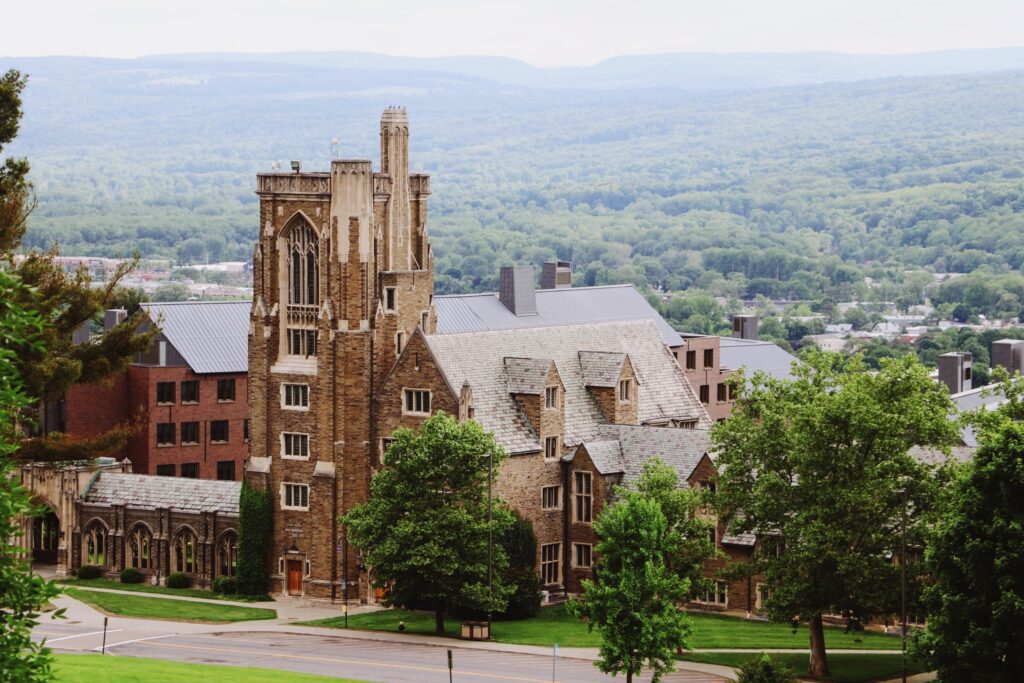
Cornell ILR
Cornell University’s School of Industrial and Labor Relations — Cornell ILR for short — is a unique Ivy League program focused on work, labor, and employment. If you’re looking for answers to questions like “What is Cornell ILR?” or “ What will I learn as an ILR student?” this guide is for you.
First, we’ll give you an overview of the school. Then, we’ll go over a few frequently asked questions, answered by a Cornell ILR alumna. Then, we’ll check out the Cornell ILR acceptance rate and give you our top three admissions tips.
Ready to jump in? Before we get the inside scoop on what it’s like to attend Cornell ILR, let’s start with a few basics.
What is Cornell ILR?
The ILR school was founded in 1945 as a statutory college — essentially, ILR is a state-sponsored school, housed within Cornell. Because of this, New York residents qualify for in-state tuition, saving about $23,000 annually.
Cornell ILR’s basic founding principle is the exploration of human behavior through the lens of the workplace. The school’s mission? Improving industrial and labor conditions through teaching, research, and outreach. The school itself has five academic departments:
- Economics
- Human Resource Studies
- Global Labor and Work
- Organizational Behavior
- Statistics and Data Science
Cornell ILR enrolls about 980 undergraduates and 180 graduate students, who join a network of more than 13,000 alumni. Undergraduates earn a Bachelor of Science in Industrial and Labor Relations. Graduate students can apply to six programs spanning industrial and labor relations, management, and human resources.
What does it mean to study labor?
Did you know the average American adult spends a third of their life working? Studying labor, work, and employment is more than just understanding economics: it’s a lens for analyzing the social structures of our world. It means understanding:
- The labor laws and acts put into place to protect workers.
- The history of labor organizing and the importance of unions and organizing in making sure that workers have rights.
- Organizational design, power relations, social norms, and more that shape the contemporary workplace.
As an ILR student you will explore the world of work in the contexts of human resource management, international and comparative labor, labor economics, labor relations, law, history, organizational behavior, and social statistics.

Cornell ILR: Frequently Asked Questions
Wondering what it’s really like to attend Cornell’s ILR School? This FAQ draws on the experience of a Cornell graduate to answer common questions about academics, student life, and more.
How did you find Cornell ILR?
I always knew I wanted to apply to Cornell, but I was initially overwhelmed by their seven different undergraduate college options. I was interested in a lot of different social science subjects, and I worried I wouldn’t be able to combine them in a single program. Then I found Cornell ILR.
When I came across the website for the Industrial and Labor Relations School (ILR), the pieces of the puzzle started coming together. I was enticed by the interdisciplinary nature of the curriculum, the specialized academic and professional resources, and the variety of international and domestic opportunities for students.
I was also excited to see such a wide range of postgraduate work. ILR alumni are in industries like social justice, finance, human resources, law. Completing a BS in Industrial and Labor Relations would allow me to explore many different aspects in the social sciences and make a real impact on the world.
What will I learn as an ILR student?
A Cornell ILR education is what you make of it. The ILR Curriculum includes a set of required courses, such as labor law, organizational behavior, economics, and human resources. Students take most of these requirements within their first two years at Cornell. During your junior and senior years, you have the opportunity to explore diverse electives both within ILR and throughout the other six colleges at Cornell.
Most students find they have enough flexibility within their curriculum that they end up pursuing 2-3 minors! I personally minored in business and inequality studies, both of which require a lot of courses already included within the ILR curriculum. As a result, I didn’t have to take as many classes to fulfill the minor requirements as peers in other colleges might have.

The class sizes are small, and you have the amazing opportunity to grow close relationships with your professors. Even for introductory, required classes, you’ll have no more than 50 students per class. (Keep in mind that introductory classes cross-listed with other colleges will be much larger.)
One of my favorite classes in the required ILR Curriculum was labor law. Not only did I have the opportunity to write several cases and learn about many labor laws and acts, but I also got to analyze and write a legal brief of my own.
What extracurricular activities do Cornell ILR students participate in?
ILR students are often leaders on campus. You’ll often see “ILRies” on the leadership committees of many organizations from speech and debate to Greek life to sports teams. There are also organizations specific to ILR students, but are open to other Cornell students as well. These organizations include:
- ILR Women’s Caucus
- Minority ILR Student Organization
- The Society for Human Resource Management
- ILR Global Affairs Club
- ILR Sports Business Society
- The People’s Organizing Collective

What resources are available to me?
Cornell ILR has some of the most specialized resources throughout Cornell University. It has its own building with its own library, a building specifically for ILR research and events, 13 renowned institutes for research, an office of student services and office of career services solely for ILR Students, and more. In addition, the class size is relatively small, so you will have the chance to get to know your advisors on a personal level.
What professional opportunities are there within Cornell ILR?
The professional opportunities as an ILR student and alumnus are abundant. ILR students have access to ILR-specific career services, which includes the ILR Career Fair, multiple workshops and networking events, and one-on-one help. Additionally, the ILR alumni network is very broad across multiple fields and industries, and they are always happy to provide a helping hand when it comes to finding job opportunities.
The ILR School also offers a credit internship program. It allows students to work full time for a semester while gaining credits for graduation, sometimes even with the opportunity to be compensated. The program has partnerships with many top organizations spanning human resources, labor relations, consulting, organizing, and more. A couple of my peers at IRL have had the opportunity to do their credit internship at Disneyland and Disney World!
The majority of students in ILR work in human resources, finance, law, labor organizing, and social justice upon graduating, but the possibilities truly are endless. For example, alumni include Dave Price, a well known journalist and weather forecaster for WNBC, Rob Manfred, the current MLB commissioner, and Randi Weingarten, the American Federation of Teachers President!

Can I study abroad?
Being an ILR student means that you have a lot of flexibility and opportunity to go abroad during summer and winter breaks or the academic year. ILR sponsors three “engaged learning opportunities” in India, Vietnam, and Zambia. Students learn about the problems that local communities face and participate in service projects to address social issues.
You can participate in an ILR Exchange program, Cornell Exchange program, or a Cornell-approved study abroad program. The ILR School partners with six top international universities for its ILR Exchange program. Students are able to earn ILR credit for both course requirements and electives. If you aren’t interested in an ILR Exchange program, you have plenty of other options with the Cornell Exchange and Cornell’s other study abroad partnerships!
Why Cornell ILR?
I initially chose ILR because I had many different interests within the realm of the social sciences, and I wanted the opportunity to explore them in different ways. Through my ILR education, I was able to do this and more. I’ve learned about the intersection of business and psychology, participated in labor relations simulations, went on a service learning trip to India, studied abroad in Spain, and ultimately gained a better understanding of what it takes to advance the world of work.
Applying to Cornell ILR: 3 Tips
After reading about what it’s like to be an ILR student, Cornell might now be at the top of your list. If it is, you need to be prepared for a competitive admissions process. Like the other Ivy Leagues, Cornell boasts a low acceptance rate of just 8%. But what about the Cornell ILR acceptance rate?
In 2025, 1,384 students applied to the ILR school. Of those students, only 217 were accepted. That puts the Cornell ILR acceptance rate around 15%, nearly double the general Cornell acceptance rate! But that doesn’t mean earning an acceptance will be any easier.
If you’re planning to apply to the ILR school, you don’t need to worry about showing “demonstrated interest”. You do need to show academic excellence and explain both your interest in and experience with ILR-related topics. Here are three admissions tips to get you started:
1. Review course offerings.
Visit the ILR department pages and spend some time exploring their course listings. This will show you what you’ll be learning in your degree program. It can also point to the experiences worth highlighting in your extracurriculars and essays.
2. Commit to test-prep.
Cornell has reinstated its standardized testing requirements, which means you are required to submit SAT or ACT scores. Don’t wait until right before your application deadline to schedule your test. Try taking a practice test to see which exam plays more to your strengths. Then, hit the books and sign up for your first test. (Cornell superscores, so it’s worth re-testing for a higher score!)
3. Craft a stellar essay.
In addition to the Cornell University essay question, applicants to the ILR school must write a school-specific essay. (You can find the prompt here.) In your essay, you’ll need to explain your specific interests within ILR and why they matter to you. That means digging into the why, being reflective, and exploring your future academic and career goals.
Getting into Cornell’s School of Industrial and Labor Relations isn’t easy. But, with the right preparation and planning (and maybe even a dedicated college advisor in your corner),you can create an application that leaves a lasting impression.

This guide to the Cornell ILR school was written by Stefanie Tedards and Meaghan Gee, Cornell ‘19. If you want to get help writing your Cornell application essays from Meaghan or other CollegeAdvisor.com Admissions Experts, register with CollegeAdvisor.com today.